Resetting ARMs & Falling Denver Condo Prices: What Homeowners Must Know in 2026

Bryan Messick
Published November 2, 2026

By Bryan Messick, Employing Broker, CRS, REALTOR®|November 2, 2026|Mortgage & Market Analysis
⚠️ Market Intelligence Alert: Payment Shock Meets Attached Price Cooling
According to Intercontinental Exchange (ICE) data reported in the Wall Street Journal, 186,000 adjustable-rate mortgages readjust next year, increasing payments by a median $645/month initially (reaching $754/month as rate caps expand). For 2020 7-year ARMs, the median jump is 43%, or $1,269/month. In Metro Denver, where condo and townhome values have softened by 3% to 10% in select submarkets, waiting until your reset date without a plan can severely erode your equity buffer.
When homeowners chose adjustable-rate mortgages (ARMs) or negotiated 2/1 builder rate buydowns between 2020 and 2024, the prevailing wisdom was simple: "Marry the house, date the rate—you'll just refinance before the rate adjusts."
Today, that assumption is colliding with two unforgiving realities in Metro Denver: mortgage rates remain firmly in the 6% range, and the entry-level attached housing market—condos and townhomes—has shifted into balanced or buyer-favoring territory, with price cuts, rising inventory, and escalating HOA insurance dues.
The WSJ Report: 186,000 ARMs Face Monthly Payment Shock
A recent Wall Street Journal investigation, drawing on mortgage data compiled by Intercontinental Exchange (ICE), details the scale of upcoming resets:
Nationwide loans facing their first upward adjustment
Rising to $754/mo as rate caps cycle through
The single hardest-hit cohort of mortgage borrowers
From the Wall Street Journal Excerpt:
“An ARM is riskier for the borrower,” said Brad Case, chief residential economist at Homes.com. “It can really save money, provided you’re not going to stay in your house forever. And many people don’t.”
“The risk is that it resets and you’re not ready to move and that you can’t afford the extra payment,” he added.
While Andy Walden, head of mortgage and housing market research at Intercontinental Exchange, noted that many jumbo ARM borrowers possess higher liquid net worths, he emphasized that for ordinary households suddenly forced to absorb an extra $7,000 to $15,000 in annual principal and interest, the cash-flow impact is palpable.

Source: Wall Street Journal / Intercontinental Exchange
The Metro Denver Attached-Home Reality: Price Softening & Supply Surge
Nationally, single-family detached homes with ultra-low 30-year fixed rates from 2020-2021 remain locked in. But in Metro Denver's condo and townhome segments, market dynamics look completely different.
Attached homes served as the primary entry point for first-time buyers, downsizers, and young professionals between 2021 and 2024. Many of these buyers relied on 5/1 or 7/1 ARMs, or builder-funded temporary buydowns (like 2/1 and 3/2/1 buydowns on new townhome developments across Aurora, Denver, Littleton, and Lakewood) to qualify amidst peak prices.
| City / Submarket | Median Attached Price | YoY Trend | Months Supply | Market Posture |
|---|---|---|---|---|
| Denver (City Core) | $395,000 – $415,000 | -3.8% to -5.2% | 4.8 – 5.5 mos | Buyer Favored / Slower Absorption |
| Aurora (Attached) | $340,000 – $365,000 | -4.5% to -6.1% | 4.2 – 4.9 mos | Heavy Seller Concessions |
| Littleton (Attached / Condos) | $409,000 – $435,000 | -1.8% to -2.5% | 3.4 – 3.8 mos | Balanced / Micro-Pocket Dependent |
| Lakewood (Attached) | $370,000 – $390,000 | -3.2% to -4.8% | 4.1 – 4.6 mos | Elevated Days on Market (38+ days) |
| Highlands Ranch (Attached) | $485,000 – $515,000 | Flat / -0.8% | 2.8 – 3.1 mos | Stable / Top School Proximity |
*Data compiled from REcolorado MLS attached-home resale statistics (condominiums and townhomes). Individual complex performance varies significantly by HOA reserve health.
The "Triple Squeeze": Why Attached Homes Face Unique Headwinds
If you own a condo or townhome in the Denver metro area, payment pressure rarely comes from mortgage interest rate resets alone. It is almost always accompanied by two other critical financial changes:
1The Mortgage Reset or Expiring Buydown
Borrowers coming off a 2/1 buydown are moving from year-one rates of ~4.5% up to their full note rate of 6.5%+. Meanwhile, owners with 5-year or 7-year ARMs taken out between 2019 and 2021 at rates near 2.5% to 3.25% are facing caps that push rates to 5.25%–6.75% overnight. On a $350,000 loan balance, that represents a $500 to $800+ monthly jump in principal and interest alone.
2Surging Colorado HOA Master Insurance Dues
Colorado has experienced historic increases in commercial property and casualty insurance premiums for HOA master policies following severe weather and hail events. Many Denver Metro condo HOAs have doubled dues over the last 36 months—shifting monthly dues from $280 to $550, or from $450 to $825+. When combined with a $650 mortgage reset, a homeowner's monthly housing cost can surge by $1,000 to $1,400 per month without moving an inch.
3Tightening Lending Warrantability Rules
Fannie Mae and Freddie Mac condo safety guidelines require strict reserve funding (minimum 10% of annual budget allocated to replacement reserves) and scrutinize deferred maintenance. If an older building struggles with reserves or has pending assessments, it can be flagged as "non-warrantable." That eliminates low-down-payment conventional buyers, reducing the buyer pool to cash or portfolio lenders and pushing resale values downward.
Homeowner Action Plan: 5 Steps to Protect Your Financial Position
If your mortgage is scheduled to adjust within the next 6 to 18 months, or if your builder temporary buydown is expiring, here is how you should proactively protect your household balance sheet:
Step 1: Pull Your Promissory Note and Verify Your Exact Caps
Do not guess how much your rate will increase. Every ARM note specifies three cap figures (for example, 2/2/5 or 5/2/5):
- Initial Adjustment Cap: The maximum your rate can rise at the first reset (often 2% or 5%).
- Periodic Adjustment Cap: The maximum change at each subsequent adjustment (usually once every 6 or 12 months, capped at 1% or 2%).
- Lifetime Ceiling Cap: The absolute maximum rate your loan can ever reach (often your starting rate + 5%).
Step 2: Obtain a True Local Equity Audit (Not an Algorithmic AVM)
Automated valuation models like Zillow or Redfin often lag market shifts in attached housing because they fail to account for active competing inventory, HOA dues increases in your building, or pending special assessments. Request a professional Comparative Market Analysis (CMA) from an employing broker who specializes in Metro Denver condo and townhome communities to know your true net equity.
Step 3: Model the Refinance vs. Reset Math
If your ARM is adjusting from 3.0% to 5.0% under a 2% initial cap, your new rate might still be lower than current 30-year fixed rates of ~6.3% to 6.6%. In that case, riding the ARM cap for year one while setting aside extra reserves is often smarter than paying thousands in refinance closing costs. Conversely, if your initial cap is 5% and your rate will jump immediately to 7.25%, locking a fixed rate or exploring loan modification options becomes urgent.
Step 4: Explore a Loan Recast if You Have Liquid Capital
If you have liquid savings, many servicers offer a mortgage recast for a nominal fee ($250–$500) without refinancing. You pay down $15,000 to $50,000 of principal, and the lender re-amortizes your remaining balance over the original term. This can neutralize the payment jump without replacing your loan.
Step 5: Time an Orderly Exit While You Still Control Equity
If market rent cannot cover your new payment and your household budget cannot absorb the adjustment, the worst strategy is waiting until you miss a payment. Selling in spring or early summer allows you to extract your equity cleanly on your own terms, rather than competing in a high-inventory winter market when distress limits your leverage.
Concerned About an Upcoming Mortgage Reset or Condo Value Shift?
Bryan Messick offers a confidential, complimentary Mortgage & Equity Real Estate Review for Denver Metro homeowners. We review your loan terms, assess your building's current resale velocity, and provide an exact net proceeds calculation so you make decisions from clarity—not stress.
Related Mortgage & Market Insights on LivingInLittleton.com
Bryan Messick, REALTOR®, CRS, Employing Broker | Colorado License #ER100000356 | United Real Estate Prestige Denver | 720-650-7648
Disclaimer: This publication is provided for educational and market informational purposes only and does not constitute formal financial, lending, or legal advice. Loan terms and reset figures cited reflect data published by Intercontinental Exchange and the Wall Street Journal as of late 2026. For specific mortgage recommendations, always consult a licensed mortgage loan originator. Equal Housing Opportunity.
Your Next Step
See What Your Littleton Home Is Worth Today — no pressure, no obligation. I'll personally review your situation and get back to you within one business day.
Free Littleton Market Snapshot
Get this month's median price, days on market, and inventory for your ZIP code — delivered to your inbox.
Get the Free GuideI'll send your guide right away and follow up in about a week to see if you have questions. No spam — just real help from a local REALTOR®.
Related Articles
More insights on Littleton real estate & local market trends
 Market Updates
Denver New-Home Builder Incentives — Week of October 31, 2026
Tri Pointe Homes has the strongest package in Metro Denver this week: a year-one rate as low as 3.99% plus up to $40,000 in closing or design credit. Brookfield Residential has the lowest headline rate at 3.49%. Here is what each builder is offering, ranked the way that matters to your monthly payment.
 Things To Do
Still Looking for Fall Colors? 7 Beautiful Places Near Littleton and Denver This Weekend
Your late-October 2026 guide to golden cottonwoods, colorful foothills, and scenic fall walks near Littleton and Denver — seven beautiful places to see fall colors this weekend, October 23–25, 2026.
 Market Updates
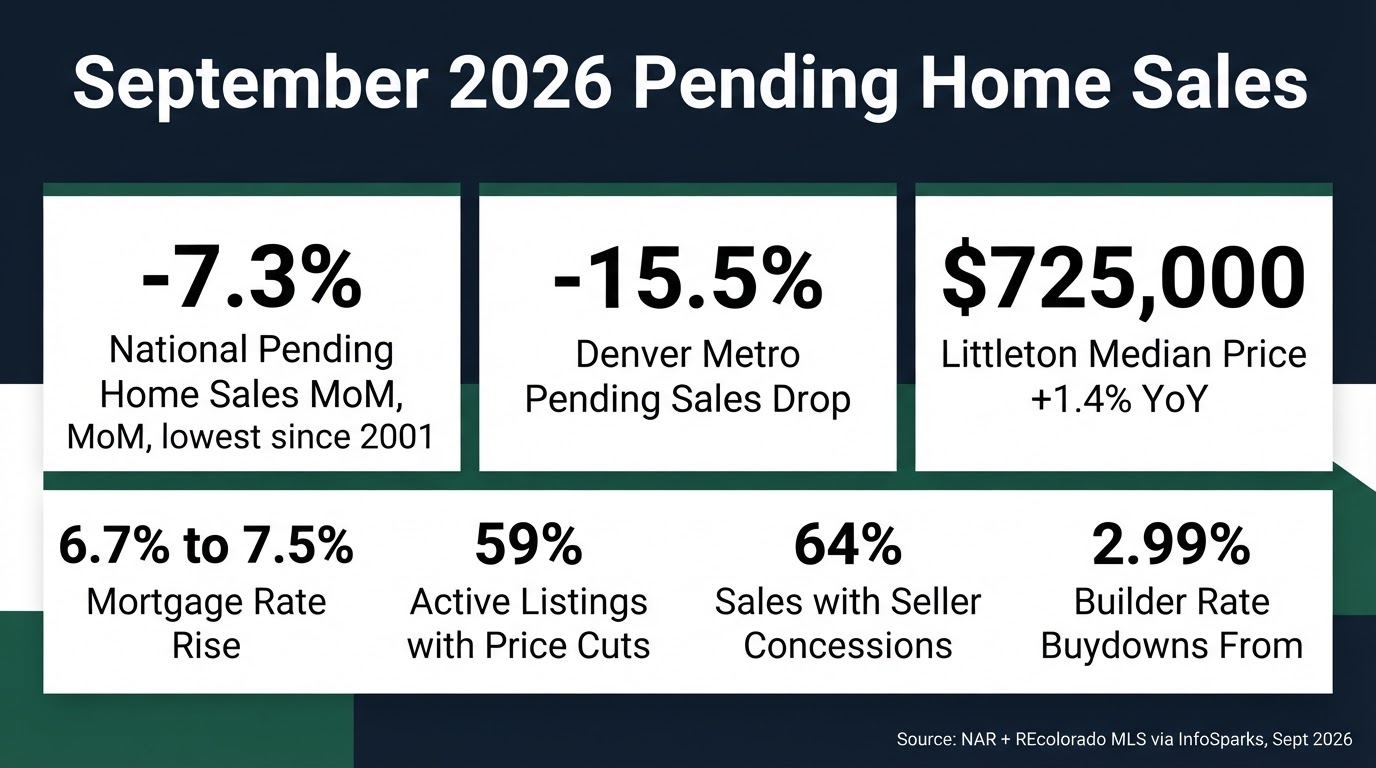
Home Contract Signings Plunged in September: What Denver & Littleton Buyers and Sellers Need to Know
National pending home sales fell 7.3% month-over-month and Denver saw a 15.5% drop after mortgage rates spiked near 7.5%. Here is what the InfoSparks data actually shows across Littleton, Highlands Ranch, and the Metro Denver cities — and the tactical playbook for buyers and sellers.
About Bryan Messick
Bryan Messick is a local real estate expert based in Littleton, serving clients throughout the Denver area. With a focus on education and modern technology, Bryan helps clients make confident decisions in any market.
Learn More About Bryan Messick